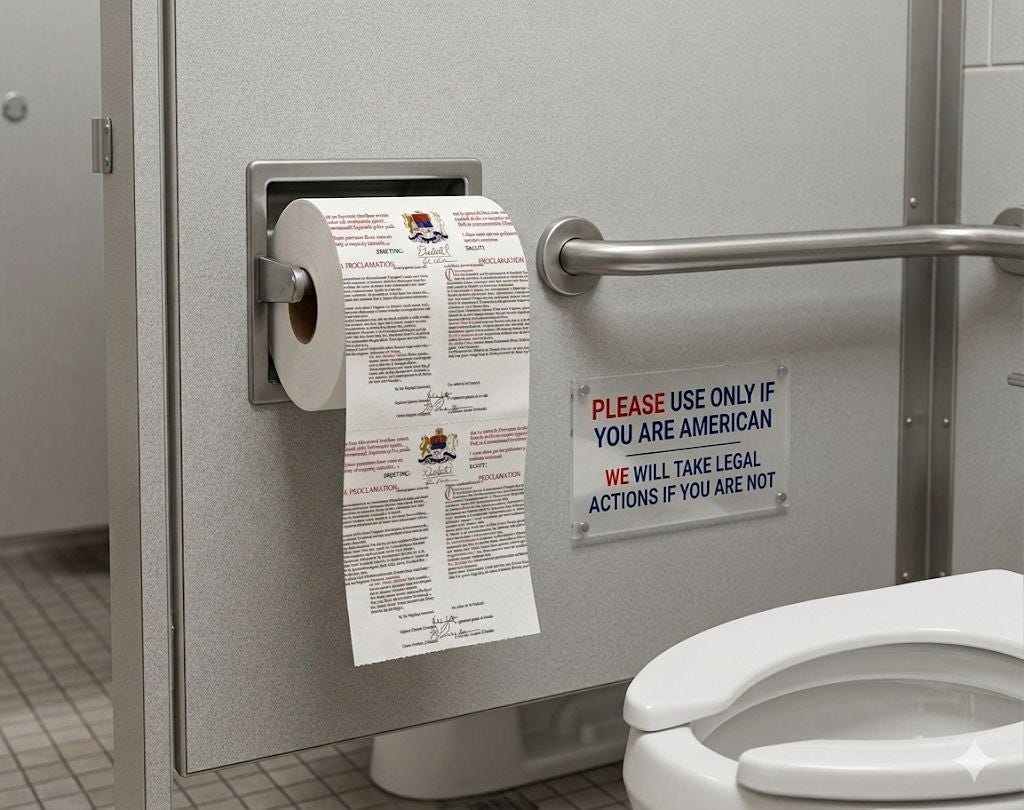
The "Toilet Papers" Signed by the "Queen of England"
A Pending Case with the Federal Court of Canada - Legal Arguments , Responses and Files
After fleeing documented persecution across multiple countries, I arrived in Canada on two crutches seeking protection. Instead, officers issued an Exclusion Order based on a technicality while disregarding visible risks, a sworn declaration, and core legal safeguards. Here’s what the record shows.
By Jace
I came to Canada after years of alleged transnational repression involving the United States and Egypt, continuous flight through several countries, and a Norwegian expulsion stamp fresh in my passport. What I encountered was not a careful assessment. It was a rushed process that prioritized administrative convenience over Canada's legal obligations. An act of transnational repression to force me back to the United States.
The Canada Border Services Agency (CBSA) Minister’s Delegate (Officer LO #20580) determined my refugee claim **ineligible** under s. 101(1)(c.1) of the *Immigration and Refugee Protection Act* (IRPA) on November 18, 2025, citing a prior claim in the United Kingdom. An **Exclusion Order** followed. The entire second interview and decision unfolded rapidly, with limited engagement on the merits of my fears.
This is not just my story — it raises serious questions about how CBSA officers exercise their gatekeeping role in life-or-death refugee eligibility determinations. This is why I had to create a public record of my case, a live man’s switch, thanks to Mark Carney’s advice:
”A country that cannot feed itself, fuel itself, or defend itself has few options. When the rules no longer protect you, you must protect yourself.”— Mark Carney, Davos.
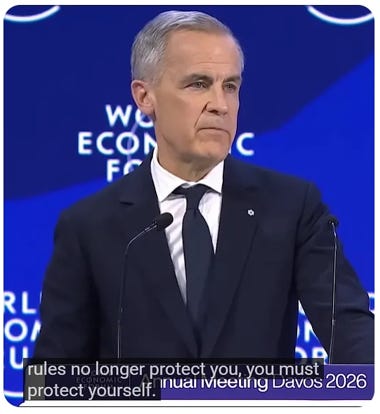
In a case like mine, financially broke after 16 escape trips, and a silent FBI, I am only left to follow Marks lead and publish my case publicly, visibility is the only shield of protection left.
The Decision on Record (Exhibit D)
Officer Lo’s notes (publicly filed in my Federal Court Application IMM-26059-25) show:
- I disclosed prior claims in Sweden, Qatar, Norway, and the UK.
The officer focused heavily on a brief UK interaction (May 2025), where I withdrew the same day due to fears mirroring my experiences in Sweden (passport demands, perceived gaslighting, non-British accents from officers).
My handwritten declaration — provided to the first officer (Johal) on October 30, detailing persecution, torture risks, and urging no return to the US under the Safe Third Country Agreement — was referenced indirectly but not substantively addressed in the final decision.
Visible evidence (crutches and knee brace from a staged incident in Egypt days after my UN torture filing, Norway expulsion stamp in my open passport) received no apparent weight.
The process moved from A44 inadmissibility report (no PR visa) to Exclusion Order without a deep risk assessment.
Officer Lo relied primarily on Officer Johal’s notes and UK documents. The decision directed me to Pre-Removal Risk Assessment (PRRA) instead of referring my claim to the Refugee Protection Division (RPD) for a full hearing.
How Canada’s CBSA Denied My Refugee Claim in Hours: A Case Study in Procedural Shortcuts, Ignored Evidence, and Charter Violations
Key Legal Violations Alleged
1. Misapplication of IRPA Sections 100 and 101: Bypassing Mandatory Eligibility Assessment**
IRPA s. 100(1) requires an officer to determine eligibility and refer eligible claims to the RPD. Section 101(1)(c.1) creates an ineligibility bar for prior claims in designated countries with information-sharing agreements (like the UK). However, this requires a **proper** prior claim with meaningful access to protection.
My England Affidavit details why the UK interaction was not substantive: immediate withdrawal due to safety fears, passport surrender demands, and patterns of harassment. Using s. 44 inadmissibility machinery to short-circuit a fulsome s. 100 analysis raises **jurisdictional error** concerns. Courts have emphasized that technical bars must not undermine Parliament’s intent for fair refugee processes.
2. Breach of Procedural Fairness and Duty of Diligence
Procedural fairness in high-stakes immigration decisions demands an unbiased process, the right to be heard meaningfully, and consideration of relevant evidence. Here:
Officers allegedly disregarded my declaration and visible corroborating evidence (injury, passport stamp).
The second interview relied on prior notes without full re-examination.
Haste in a complex case involving multi-jurisdictional flight and serious risk allegations.
Federal Court jurisprudence stresses that fairness varies with context — refugee claims affecting life and security demand higher safeguards. Ignoring material post-departure history (Norway expulsion potentially forming chain refoulement) and sur place risks (from public statements) undermines this.
3. Violations of the Canadian Charter of Rights and Freedoms
Section 7 (Life, Liberty, and Security of the Person)**: Deportation to a substantial risk of torture or persecution engages s. 7 and requires compliance with principles of fundamental justice (non-refoulement). By allegedly bypassing a proper risk assessment and relying on a questionable prior claim, the process may fail this standard. SCC cases like *Suresh* affirm Canada cannot remove individuals to face torture where there is a sufficient connection to Canadian action.
Section 15 (Equality)**: Differential treatment in accessing protection mechanisms, particularly given my Christian conversion and dual-citizenship complexities, could raise equality concerns.
4. International Obligations
Canada’s duties under the 1951 Refugee Convention and Convention Against Torture (CAT Art. 3) prohibit refoulement. A mechanical application of ineligibility without grappling with my documented flight narrative and UN filing risks breaching these.
Broader Implications
My case — documented extensively in the Applicant’s Record with affidavits, medical reports, travel itineraries, and public statements — highlights systemic pressures on frontline officers. While CBSA must manage volume and security, shortcuts in complex protection claims can erode Canada’s humanitarian commitments and expose individuals to irreparable harm.
I am pursuing judicial review in Federal Court (IMM-26059-25), seeking to quash the decision and obtain a proper RPD referral. I have requested the full Certified Tribunal Record and sought consent to judgment to resolve efficiently.
Why This Matters
Refugee protection is not a bureaucratic checkbox. When officers issue Exclusion Orders while visible evidence of risk sits on the table — crutches from a recent attack, fresh expulsion stamps, sworn declarations — it demands scrutiny. Canadians deserve a system that upholds the rule of law, Charter rights, and international reputation.
I invite readers, legal experts, journalists, and policymakers to examine the public court filings. True accountability strengthens, rather than weakens, our immigration system.
Finally:
What happened at Toronto airport was not a procedural failure. It was a betrayal of sovereignty under the clause “intelligence sharing” - for a man who is not a threat to Canada, was not a threat to the United States either.
I arrived on two crutches, a visible and documented victim of torture, with a fresh Norwegian expulsion stamp in my passport and a handwritten declaration invoking Canada’s Charter and international law. Within two hours, CBSA reduced my case to a technicality.
They did not assess my risk. They did not read my evidence. They obeyed a script — and that script was written in Washington, not Ottawa. Sovereign Canada, from an immigration officer who sympathized with my persistent dry and loud coughing , to a man who blindly dismissed me on a wheel chair not leading me where to go.
The country that claims to uphold human rights and the Charter signed by the Queen of England has become obedient to America, trashing its sovereignty over its borders, land, and laws.

The same Queen who made the Commonwealth her life’s work, and whose constitutional role was built on three rights: *the right to be consulted, the right to encourage, and the right to warn*. She used those rights to hold nations to the standards of dignity, sovereignty, and mutual respect.
The same Queen who personally appointed Egyptian-born heart surgeon Sir Magdy Yacoub to the Order of Merit in 2014, and knighted him in 1992 for pioneering transplant surgery that saved thousands of lives. She honored Dame Nemat Shafik for public service, Bishop Angaelos for religious freedom, and Inas Ibrahim Helal for community work — Egyptians recognized for healing, serving, and protecting human dignity. That record of uplifting people stands in direct contrast to systems that now ignore evidence, dismiss the vulnerable, and abandon sovereignty. Throughout her 70-year reign, Her Majesty extended British honors to Egyptian citizens who advanced human dignity and public service. Deputy Governor of the Bank of England Dame Nemat Talaat Shafik, born in Alexandria, was made Dame Commander of the Most Excellent Order of the British Empire for her services to public administration and the global economy. Bishop Angaelos, General Bishop of the Coptic Orthodox Church in the UK, born in Cairo, was appointed Officer of the Most Excellent Order of the British Empire for his services to international religious freedom. Egyptian community leader Inas Ibrahim Helal was honored at Buckingham Palace for charitable works and local community service in London.
Globally, the Queen defined her reign by transforming the “imperial family” into a voluntary Commonwealth of equal, sovereign nations. She told the UN General Assembly that leadership meant “encouraging people to combine their efforts, talents, insights, enthusiasm and inspiration, to work together.” Secretary-General António Guterres called her “an anchor of stability across decades of often turbulent history” who helped form the Commonwealth as a diverse multilateral group when many nations gained independence from Britain. Prime Minister Portia Simpson Miller said the Queen displayed “great political skills that have helped to defuse tensions in international relations.”
She did not need to persecute or marginalize Arabs to keep herself feeling superior, she did not adapt to the CIA constitution. That record — honoring Egyptians for service to humanity, building a Commonwealth “built on friendship, loyalty, and the desire for real freedom and real peace,” and using diplomacy to defuse tensions — stands in direct opposition to dismissing vulnerable people on a wheelchair, ignoring evidence, and obeying a script that abandons sovereignty.
What did Canada do?
It made its human rights charters less valuable than toilet papers — useless not useful, in my case, in my case instead of relying on Canada’s sovereignty, human rights charters, I am now relying on live-man’s switches, in the hope that Canadians do not kill me in Canada to protect the face of the democracy of America, the CIA that tortured me with sound waves, and the FBI who remained silent about my case.
Download my official case files at the Federal Court Google Drive
https://drive.google.com/drive/folders/1xG0qBTP3l-eVA9L3kiZM8hFVs5ugbun8?usp=drive_link
Download my case files from my case website: https://bazjace.wixsite.com/jacerealstory
Or from Google Drive:
https://drive.google.com/drive/folders/13WQaidXAsMlG2g8O6tuYTgKHnbni2yIO?usp=drive_link


Comments
Post a Comment